17 Jul 2026
Charting Modular PSU Cable Configurations Through Distributed Community Testing for Stable Multi-GPU Arrays
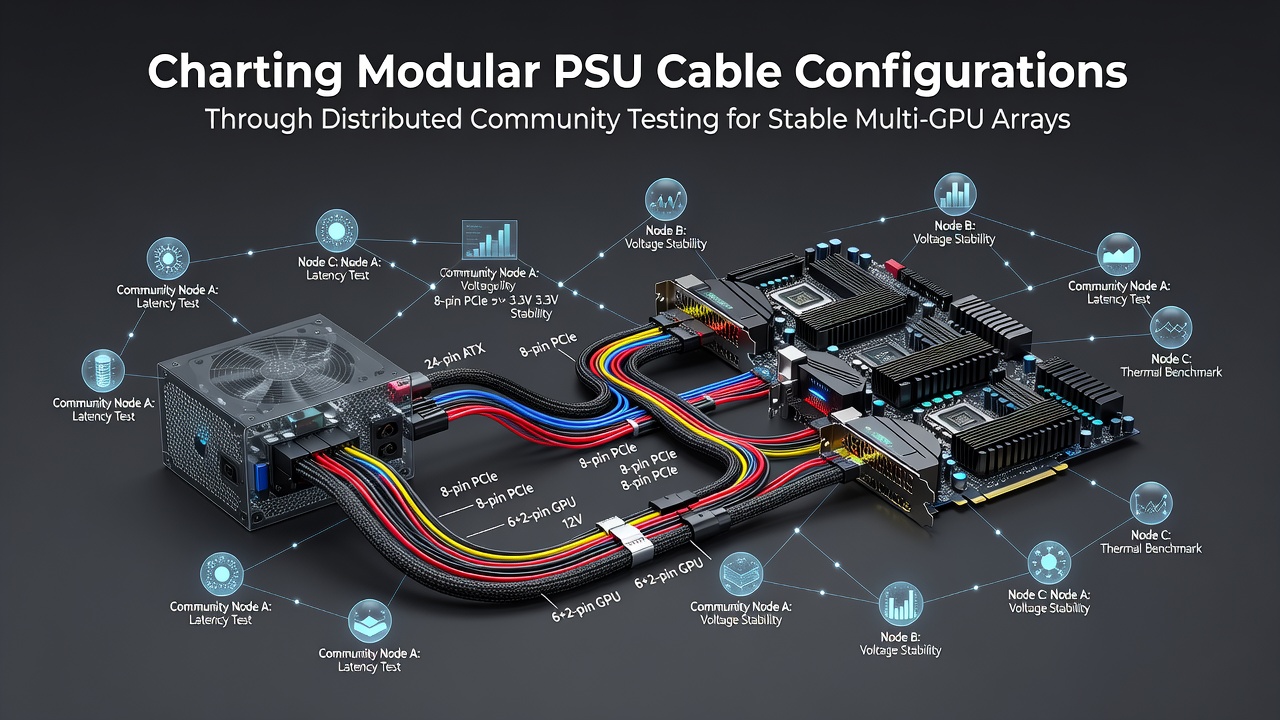
Distributed community testing initiatives have mapped modular power supply unit cable configurations that maintain stability across multi-GPU arrays, with coordinated efforts accelerating through mid-2026. Groups of hardware enthusiasts and engineers share test results on voltage drop measurements, connector pinouts, and load balancing patterns that support configurations with four or more graphics processors drawing simultaneous high current.
Community-Driven Data Collection Methods
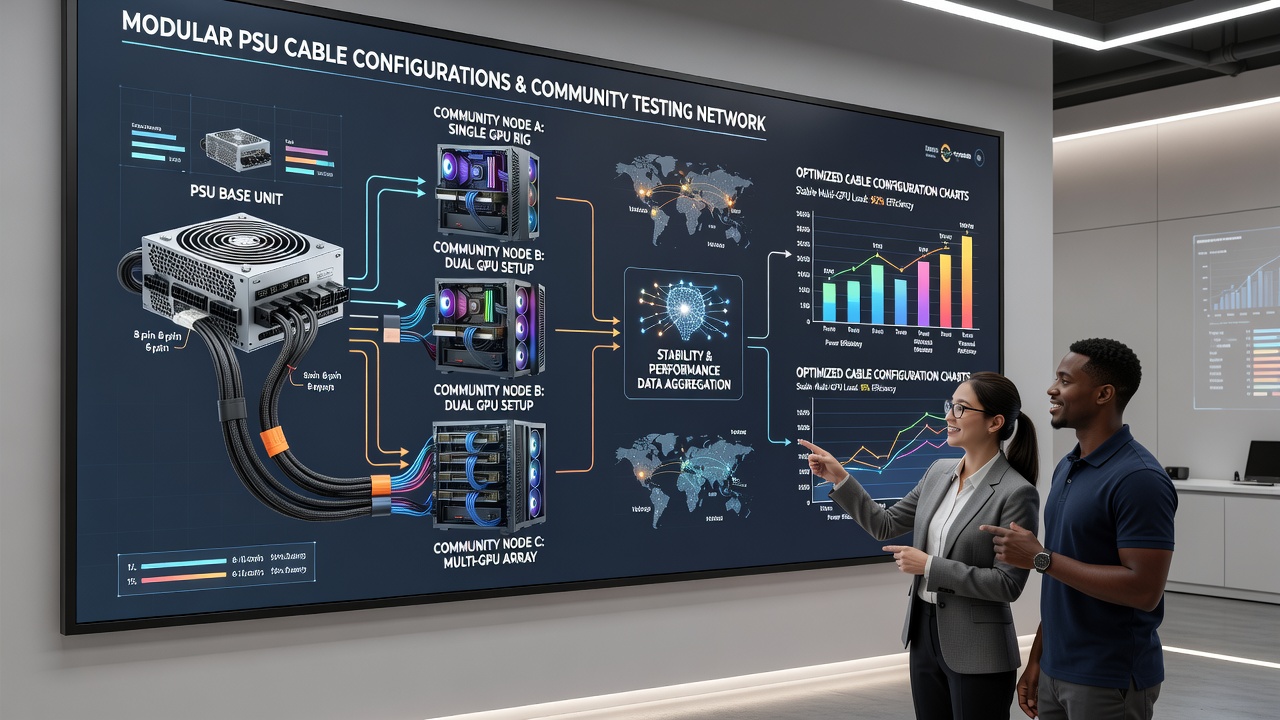
Participants in these projects deploy standardized test rigs that include oscilloscopes, current probes, and logging software to record power delivery under sustained loads. Data flows through shared repositories where contributors upload readings from specific cable lengths, wire gauges, and connector types such as 8-pin and 12VHPWR variants. By July 2026 several repositories had accumulated over 12,000 individual test runs covering more than 40 distinct modular PSU models from multiple manufacturers.
Testing protocols require each participant to run identical synthetic workloads that simulate rendering, compute, and mining tasks while monitoring rail stability within a 5 percent tolerance band. Results are cross-verified by independent labs before inclusion in the master dataset, which now tracks variables including cable temperature rise, contact resistance, and transient response during sudden load changes.
Key Configuration Patterns Identified
Analysis of aggregated results reveals that daisy-chained 8-pin cables exhibit measurable voltage sag beyond 300 watts per connector when paired with high-power GPUs released after 2024. Configurations using dedicated cables per GPU, routed through separate PSU modular ports, show lower deviation in delivered voltage across all tested arrays. Observers note that splitting power delivery across multiple 12-volt rails within the same PSU further reduces imbalance when four or more cards operate concurrently.
Wire gauge selection emerges as another critical factor. Community datasets indicate that 16 AWG conductors maintain acceptable drop at lengths up to 60 centimeters under 450-watt loads, whereas 18 AWG cables require shortening or parallel runs to achieve comparable performance. Participants have documented successful 6-GPU builds using custom-length cables fabricated from 14 AWG stock with reinforced terminals at both ends.
Geographic Distribution of Testing Nodes
Testing nodes operate across North America, Europe, and East Asia, with each region contributing hardware variants common to local markets. North American contributors frequently test high-wattage platforms from domestic assemblers, while European teams focus on efficiency certifications required under regional directives. East Asian groups have supplied extensive data on compact form-factor PSUs adapted for dense rackmount multi-GPU servers.
Validation Against Industry Standards
Results align with guidance from the National Institute of Standards and Technology on power delivery margins for dense computing clusters. The community dataset extends these guidelines by quantifying real-world margins available when using consumer-grade modular cables rather than enterprise-grade bus bars. Cross-checks against European Committee for Electrotechnical Standardization reports on connector durability confirm that repeated insertion cycles beyond 200 reduce contact integrity unless gold-plated terminals are employed.
Additional validation comes from collaborative work with academic partners who apply statistical models to the crowdsourced measurements. These models predict failure thresholds under varying ambient temperatures and airflow conditions, helping builders anticipate derating requirements when enclosing multiple GPUs in restricted chassis volumes.
Practical Implementation Examples
One documented build completed in early 2026 used four 4090-class cards powered by a single 2000-watt modular unit. Testers routed individual 12VHPWR cables directly from separate modular sockets, avoiding any pigtail adapters. Logging showed rail voltages remained within 2 percent of nominal during 48-hour stress periods. Another configuration paired six older 3080 cards with a 1600-watt supply using 16 AWG extensions limited to 45 centimeters, achieving stable operation after community members replaced the original 18 AWG factory cables.
Distributed teams continue to refine cable labeling schemes so subsequent contributors can replicate exact pinouts without reverse-engineering each PSU. Shared spreadsheets now include color-coded diagrams and measured resistance values for every tested cable variant.
Conclusion
The collective mapping effort demonstrates that systematic, distributed testing produces actionable cable configuration data for multi-GPU stability. Builders reference these shared findings to select wire gauges, connector types, and routing strategies that match their specific PSU and GPU combinations. Ongoing contributions through July 2026 and beyond continue to expand the dataset, covering emerging power connectors and higher-density card arrays.