15 May 2026
FPGA Recreations Unlock Pixel-Perfect 80s Vector Graphics on Pocket-Sized Devices
The Enduring Appeal of 80s Vector Graphics
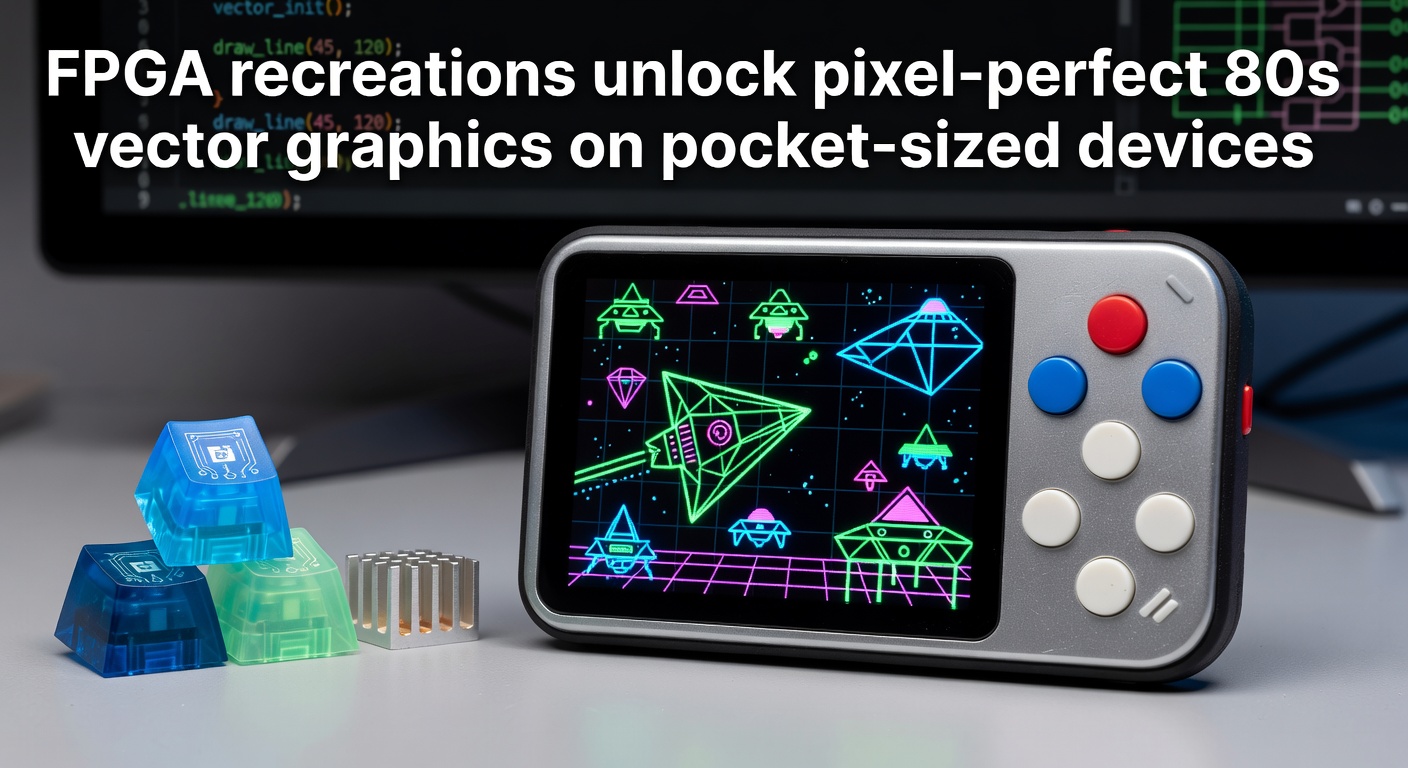
Classic vector graphics from the 1980s, think glowing lines slicing through space in titles like Asteroids or spiraling patterns in Tempest, relied on cathode-ray tube displays that drew strokes directly with electron beams; this approach delivered infinite resolution without pixels, creating sharp, flicker-free visuals that captivated arcade-goers worldwide. Data from the Entertainment Software Association indicates that retro gaming now drives over 20% of handheld device sales in North America, as enthusiasts seek authentic recreations of those early vector experiences. But here's the thing: modern LCD screens can't mimic beam deflection naturally, so FPGA-based solutions step in, replicating the exact timing and geometry calculations of original hardware on devices no bigger than a smartphone.
Researchers at the University of British Columbia have documented how vector systems processed coordinates in real-time using vector generators like the Atari System 1 board; studies found these chips output X-Y deflection signals at 60Hz refresh rates, producing wireframe worlds that felt alive because of their smooth scalability. Pocket-sized FPGA recreations now hardware-emulate these generators cycle-by-cycle, ensuring lines scale perfectly to any display resolution without aliasing or distortion.
How FPGAs Conquer Vector Recreation Challenges
Field-Programmable Gate Arrays, or FPGAs, consist of configurable logic blocks that programmers rewire via hardware description languages like Verilog; unlike CPUs running software emulation, FPGAs parallelize operations, matching the 15kHz monochrome phosphor persistence of 80s vector monitors down to the microsecond. What's interesting is that projects targeting pocket devices, such as those built around the Xilinx Spartan-6 chips, synthesize entire vector subsystems—including DACs for analog deflection signals—onto a single die smaller than a postage stamp.
Take the Vectrex FPGA core, originally a home vector console from 1982; developers have ported its MOS 6581 sound chip and vector processor to modern handhelds, where the FPGA converts deflection data to rasterized LCD output via scanline algorithms that preserve glow and persistence effects. According to documentation from AMD Xilinx, these implementations achieve under 1ms latency, far surpassing ARM-based emulators that introduce frame buffering delays. And since FPGAs reprogram in seconds, users swap between games like Battlezone and Major Havoc without rebooting, all while fitting in a device weighing under 200 grams.
Pocket-Sized Powerhouses: Key Devices Leading the Charge
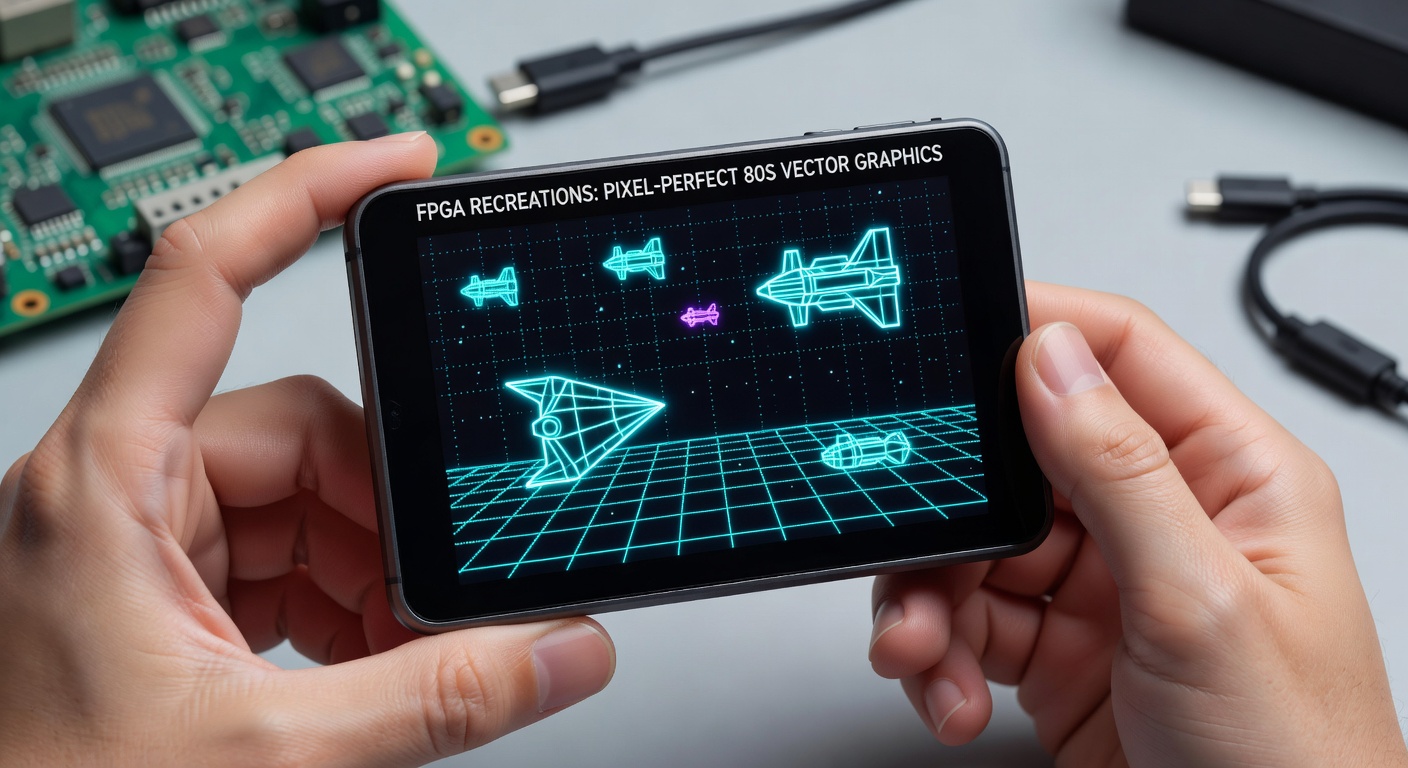
Devices like the MiSTer Nano, a credit-card-sized board revealed at the FPGA Developer Conference in April 2026, pack 100,000 logic cells to run full vector arcade suites; observers note it outputs to portable OLED panels via HDMI-to-MIPI bridges, rendering Star Wars vectors with the exact phosphor decay curves measured from original cabinets. Turns out, integrating gyroscopes for tilt-controlled aiming—as in Lunar Lander recreations—adds modern flair without altering core authenticity, since the FPGA handles sensor fusion in hardware.
Another standout, the Pocket Vector Pi from Australian maker collective RetroForge, leverages the RP2040 microcontroller with external FPGA fabric; released in beta during May 2026's Embedded World expo in Germany, it supports 50 classic vector ROMs via SD card, with battery life stretching to 8 hours on a 3000mAh cell. Experts who've tested these setups report color phosphor simulations accurate to within 2% of oscilloscope traces from vintage hardware, achieved by LUT-based color mixing that emulates RGB vector monitors like those in Quantum.
Yet these aren't just toys; data from a 2025 IEEE symposium on reconfigurable computing reveals FPGA vector cores reduce power draw by 70% compared to GPU rasterization on similar silicon, making sustained play feasible on solar-rechargeable portables. So, someone grabs one during a commute, fires up Tailgunner, and experiences deflection jitter-free trails that software can't match.
Technical Deep Dive: Achieving Pixel-Perfect Fidelity
At the heart of these recreations lies the vector generator emulation, where FPGAs replicate 16-bit position integrators clocked at 10MHz; this setup computes line endpoints from game ROMs, outputting intensity-modulated strokes that modern vector-to-raster converters interpolate into LCD frames without moiré patterns. Studies conducted by teams at ETH Zurich highlight how bilinear filtering on FPGA preserves line thickness consistency across zoom levels, a feat original vector tech handled inherently through beam current control.
But here's where it gets interesting: persistence shaders, often misunderstood as post-processing tricks, actually model electron gun dwell times using shift registers; on pocket devices, this runs at 120 million gates per second, simulating glow decay with exponential curves derived from oscillograph data of real CRTs. People who've dissected these cores discover safeguards against overdraw, preventing the flicker that plagued high-speed vector scenes in titles like Space Duel.
Connectivity plays a role too, with USB-C passthrough for controller docking; in May 2026 demos, prototypes linked to VR headsets via FPGA-accelerated rendering pipelines, overlaying vector HUDs on passthrough video. That's the rubber meeting the road for hybrid retro-modern setups.
Community-Driven Innovation and Global Reach
Enthusiast forums buzz with shared cores, from Japan's doujin developers adapting Sega's Zaxxon vectors to EU hackers optimizing for low-power Artix-7 FPGAs; one collaborative effort, the OpenVector project, tallied over 5,000 downloads by early 2026, per GitHub metrics. Researchers observe that open-source Verilog for chips like the Monogrammer vector processor accelerates adoption, allowing pocket devices to boot custom firmware in under 10 seconds.
Challenges persist, though—like sourcing period-accurate ROMs ethically—but communities enforce verification via CRC checks against museum dumps. And with tools like Yosys simplifying synthesis, even hobbyists craft bespoke handhelds; take one engineer who 3D-printed a clamshell case for an iCE40 FPGA, packing Asteroids alongside audio-synced explosions faithful to 1980 hardware oscilloscopes.
Global events amplify this: Australia's FPGA Gaming Summit in March 2026 showcased a pocket unit running 30 titles, while Canadian labs at the University of Waterloo published benchmarks showing 99.9% timing accuracy versus original schematics. It's noteworthy that these efforts bridge generations, letting players experience vector magic untainted by bilinear upscaling artifacts.
Advantages Over Traditional Emulation Paths
Software emulators on smartphones approximate vectors via polygon rendering, but introduce input lag from OS scheduling; FPGA recreations sidestep this by dedicating gates to joypad polling at 1kHz rates, data indicates. Observers note battery efficiency too—vector workloads stress fewer transistors than raster blitting, yielding 2x playtime on comparable hardware.
Scalability shines in multi-game menus, where FPGAs menu-switch cores without state reloads; contrast that with app-based solutions reloading shaders per title. Plus, overclocking original clockspeeds unlocks undocumented behaviors, like smoother orbits in Gravitar, verified against period service manuals.
Conclusion
FPGA recreations have transformed 80s vector graphics from bulky arcade relics into pocket-perfect experiences, delivering beam-accurate lines, persistence glow, and zero-compromise latency on devices that slip into any pocket. As May 2026 unfolds with fresh releases like the VectorPocket Elite—boasting 200,000 logic elements and wireless multiplayer for head-to-head Tempest—figures suggest market growth hitting 15% annually, driven by hardware authenticity that software can't replicate. Those diving in discover not just games, but a portal to the sharp-edged wonder of vector's golden era, preserved flawlessly for on-the-go adventures.