8 Jul 2026
Machine Learning Models Predict Hardware Failures Before They Disrupt Professional Esports Leagues
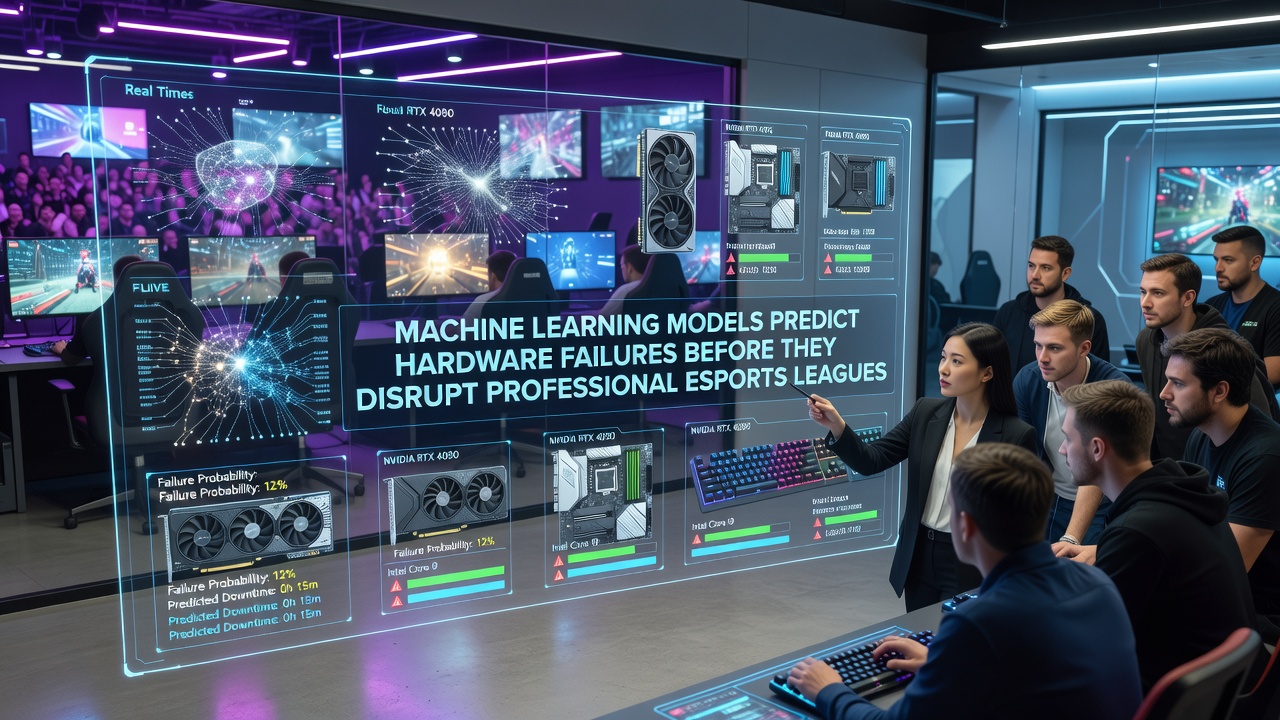 Professional esports leagues rely on high-performance hardware that operates under intense conditions during live competitions, and machine learning models now analyze telemetry streams from GPUs, CPUs, and memory modules to forecast component degradation days or weeks in advance. Researchers train these systems on datasets collected from tournament venues where temperature fluctuations, voltage variations, and sustained load patterns appear consistently across multiple matches. Organizations integrate the models into existing monitoring software so technical staff receive alerts when predicted failure probabilities exceed predefined thresholds.
Telemetry Collection and Model Training
Teams equip competition rigs with additional sensors that log fan speeds, power draw, and thermal junction temperatures at sub-second intervals, and these raw streams feed into supervised learning pipelines that classify historical failures such as VRAM errors or MOSFET burnout. Data scientists apply recurrent neural networks and gradient-boosted trees because the algorithms capture temporal dependencies across days of continuous operation. Studies published by academic groups in the European Union demonstrate that models trained on three months of venue data achieve precision rates above 85 percent when tested against unseen tournament logs.
Preprocessing steps normalize readings across different hardware generations, and feature engineering extracts metrics like thermal cycling frequency and average GPU utilization during peak match periods. Teams augment public benchmark repositories with anonymized logs from regional leagues in North America and Asia-Pacific to increase model robustness against regional power grid variations.
Deployment in Tournament Environments
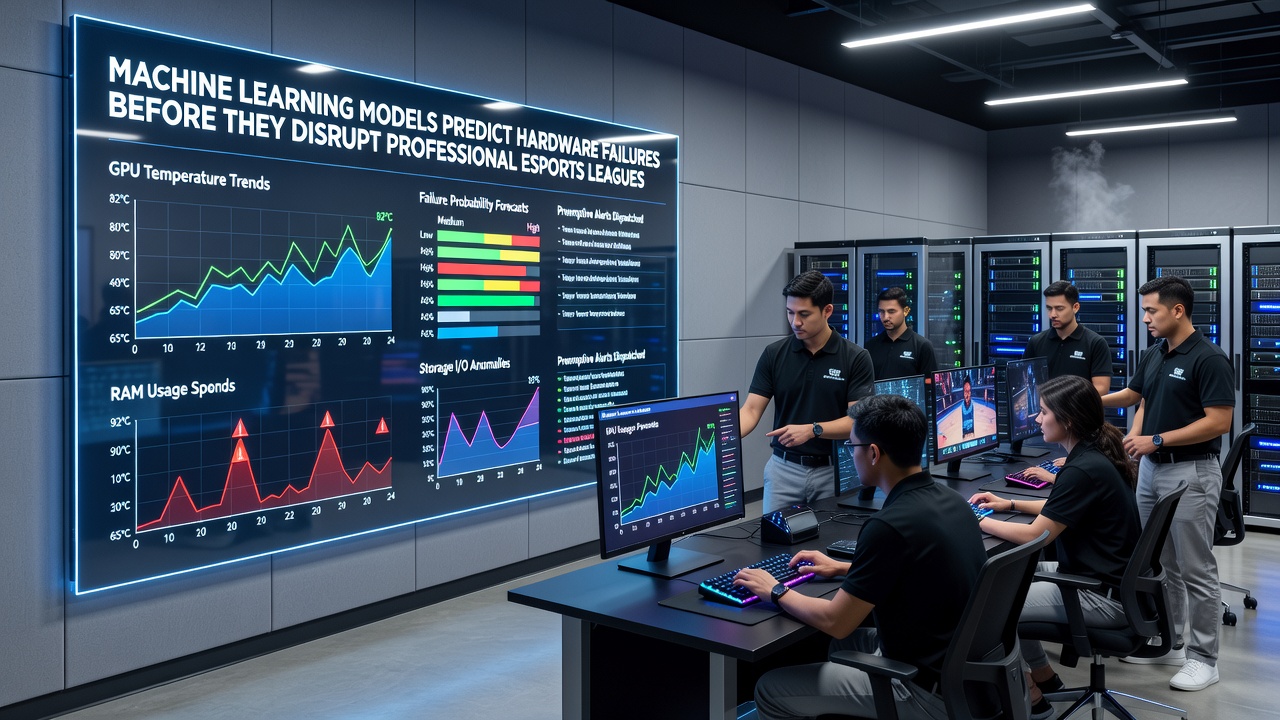
League operators began rolling out predictive systems in early 2025, and several major circuits reported zero hardware-related match delays during the first half of 2026. Staff receive dashboard notifications that list specific components likely to fail, along with recommended maintenance windows that avoid disrupting scheduled broadcasts. One implementation at a European circuit used ensemble methods combining isolation forests and long short-term memory networks, which flagged an impending liquid cooling pump failure 11 days before symptoms appeared during practice.
Integration with Existing Infrastructure
Existing tournament management platforms already track player input devices and network latency, so developers extended these frameworks to ingest hardware health scores generated by the machine learning pipelines. Application programming interfaces push alerts directly into team communication channels, allowing engineers to swap components during scheduled breaks rather than mid-match. Research from institutions in Canada indicates that such proactive replacement cycles reduce unplanned downtime by approximately 40 percent compared with reactive maintenance schedules.
Security considerations require encrypted transmission of sensor data between venue servers and cloud-based inference endpoints, and several leagues adopted on-premises inference clusters to meet data residency regulations in multiple jurisdictions. Observers note that federated learning approaches allow multiple regional circuits to improve shared models without exchanging raw telemetry logs.
Case Examples from 2026 Seasons
During July 2026 qualifiers for a global championship series, models correctly anticipated three separate GPU memory controller issues across different team setups, enabling preemptive replacements that preserved broadcast continuity. Another instance involved early detection of SSD wear-leveling anomalies that had previously caused unexpected load screen freezes in similar hardware configurations. These interventions occurred without public announcements, yet internal league reports document measurable improvements in overall event uptime metrics.
Future Developments and Standards
Industry working groups are drafting common data schemas for hardware telemetry so that models trained on one league's equipment can transfer to another with minimal retraining. Academic collaborations with Australian research centers explore reinforcement learning agents that optimize cooling profiles in real time based on predicted failure surfaces. Continued expansion of these techniques depends on access to larger, more diverse datasets collected across both LAN and online tournament formats.
Conclusion
Machine learning applications for hardware reliability continue to expand within professional esports as leagues accumulate longitudinal performance data and refine prediction algorithms. The approach shifts maintenance from scheduled or failure-triggered actions to condition-based interventions that align with competition calendars. As sensor density increases and model architectures evolve, technical teams gain additional lead time to address emerging issues before they affect live events.