5 Jun 2026
The Spread of Sensor Fusion Algorithms Across Wireless Input Devices for Multiplayer Coordination

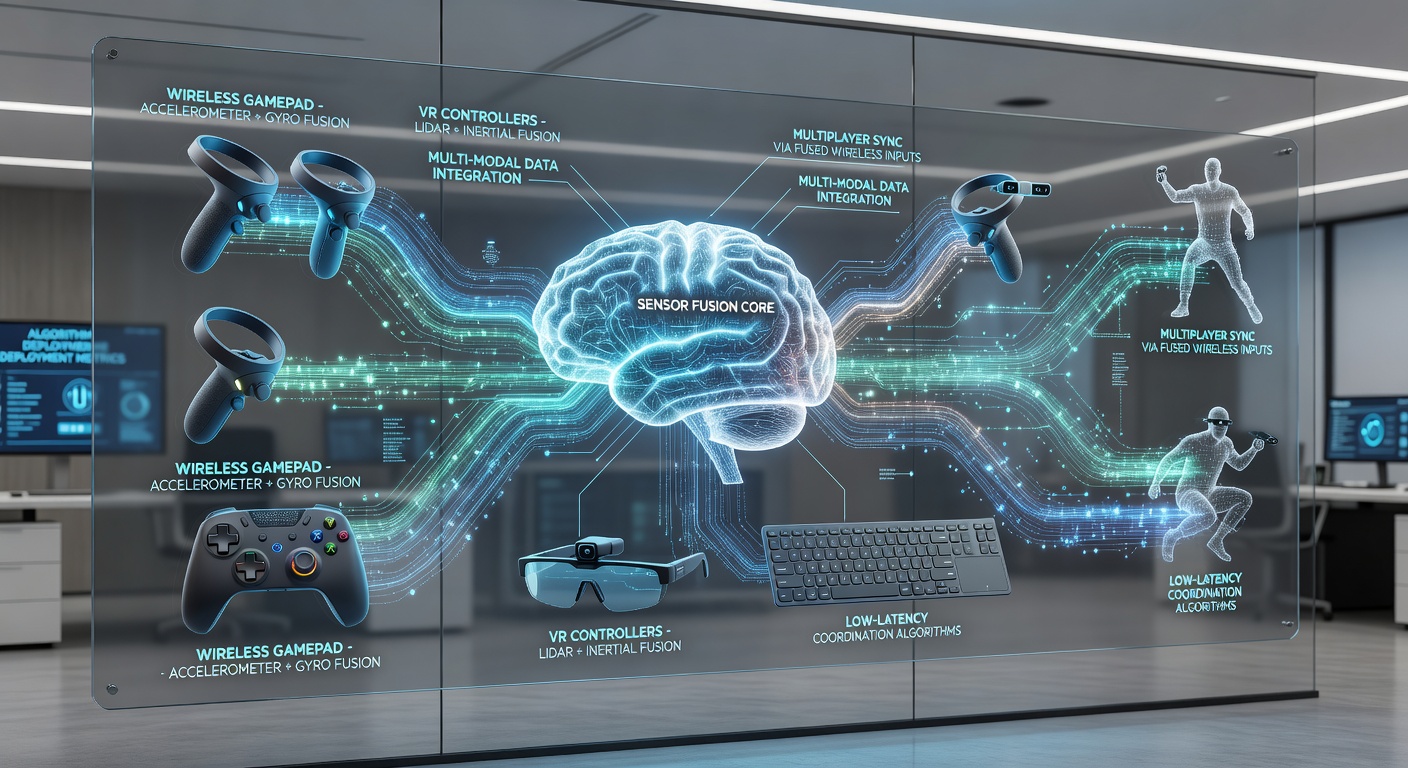
Sensor fusion algorithms combine data streams from accelerometers, gyroscopes, magnetometers and other onboard components in wireless input devices, and this integration has expanded rapidly into multiplayer gaming environments where precise coordination between players matters most. Manufacturers embed these algorithms directly into controllers, mice and headsets so that motion tracking remains stable even when multiple devices operate on the same wireless network, and the result is reduced packet loss plus smoother synchronization during team-based matches.
How Sensor Fusion Works in Wireless Peripherals
Wireless devices collect raw readings at high sampling rates yet each sensor carries its own noise characteristics and latency profile, so fusion algorithms apply Kalman filters, complementary filters or machine-learning models to produce a single coherent output stream. Engineers calibrate these models against known motion patterns before devices reach consumers, and firmware updates refine the weighting coefficients over time to match new radio environments or battery conditions. In multiplayer sessions this matters because one player's input lag can disrupt the shared game state for everyone else on the server, therefore consistent fusion across all controllers keeps collective response times within acceptable bounds.
Standards bodies have published interoperability guidelines that encourage consistent sensor-fusion implementations across brands, and several chipset vendors now license reference libraries that include pre-tuned fusion stacks for 2.4 GHz and Wi-Fi 6E radios. Adoption accelerated after 2024 when major esports organizers began requiring certified low-latency hardware for official tournaments, prompting peripheral makers to integrate the same algorithmic core rather than develop proprietary solutions from scratch.
Multiplayer Coordination Benefits
Teams that practice with sensor-fused wireless gear report tighter execution of coordinated maneuvers such as simultaneous ability activations or flanking routes because each player's device transmits position and orientation data with sub-millisecond variance. Network monitoring tools used at tournament venues capture aggregate telemetry showing that fusion-enabled setups experience fewer desync events when eight or more players share the same access point. Observers note that audio cues delivered through wireless headsets also benefit since head-tracking fusion keeps spatial audio aligned with actual player movement, preserving directional information critical for callouts.
Deployment Patterns Observed in 2025-2026
By June 2026 several professional leagues had standardized on wireless controller profiles that mandate fusion algorithm version 3.2 or higher, and data from event organizers indicate a measurable drop in input-related disputes. University labs in North America and Europe have published comparative studies on fusion performance under dense 2.4 GHz interference, confirming that hybrid inertial-radio fusion outperforms pure inertial methods once player counts exceed four per channel. Meanwhile Asian manufacturers introduced dongles that offload part of the fusion computation to the USB receiver itself, freeing onboard batteries while maintaining the same output precision.
Technical Challenges and Industry Responses
Power consumption remains a constraint because continuous sensor polling plus algorithmic processing drains batteries faster than simpler polling schemes, yet newer chipsets incorporate duty-cycling logic that activates high-rate fusion only during active gameplay windows. Interference from neighboring tournament stations can still corrupt magnetometer readings, so many devices now include automatic recalibration routines that trigger when signal-to-noise ratios fall below preset thresholds. Industry groups such as the Entertainment Software Association have begun documenting best-practice calibration sequences that teams can apply before matches begin.
Academic researchers continue to explore neural-network approaches that adapt fusion weights on the fly based on detected movement patterns, and early field tests at collegiate esports events show promising latency reductions in fast-twitch genres. Regulatory attention has also surfaced in the form of spectrum-allocation discussions within the Innovation, Science and Economic Development Canada framework, which evaluates how dense wireless deployments affect both gaming and adjacent services.
Future Trajectory
Component suppliers forecast that by late 2027 most mid-range wireless peripherals will ship with on-chip fusion accelerators rather than relying solely on microcontroller firmware, and this shift should further lower per-device variance across large player groups. Open-source fusion libraries are gaining traction among smaller accessory makers, allowing consistent behavior even when hardware differs, while closed ecosystems continue refining proprietary models tuned to specific radio stacks. Tournament infrastructure providers now bundle sensor-health dashboards that display real-time fusion confidence scores for each connected device, giving technical staff visibility into potential coordination issues before they surface in match play.
Conclusion
The integration of sensor fusion algorithms into wireless input devices has produced measurable improvements in multiplayer synchronization, and ongoing refinements in both hardware and software continue to support larger, more complex coordinated events. As adoption widens and standards mature, the same techniques underpin not only competitive gaming but also emerging applications in training simulators and remote collaboration platforms that rely on shared spatial awareness. Data from multiple regions indicate sustained investment in these technologies through 2026 and beyond.