23 Aug 2026
Tracing the Lineage of Voxel-Based Rendering Techniques from Early 3D Experiments to Contemporary Indie Survival Games
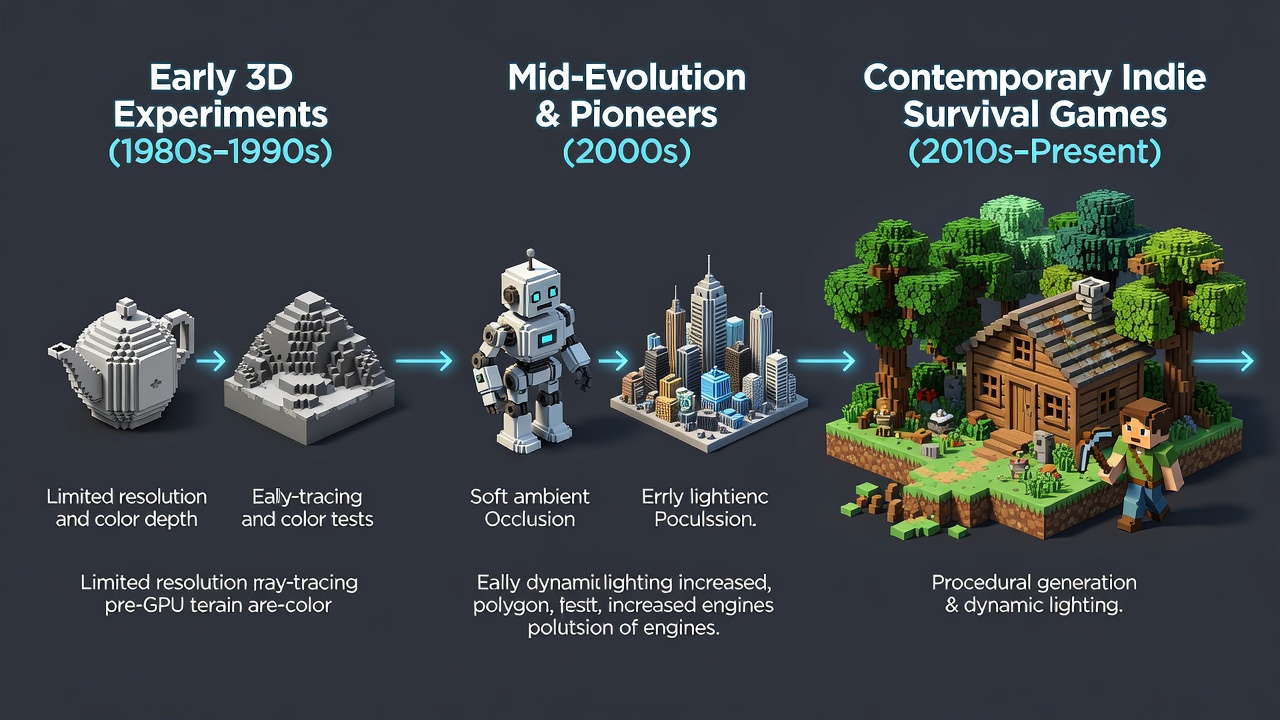
Researchers trace voxel rendering back to the 1970s when medical imaging systems first used three-dimensional grids of volume elements to reconstruct CT scan data, and this approach soon moved into computer graphics labs where engineers tested discrete volume representations instead of continuous surfaces. By the late 1980s flight simulator developers adopted voxels for terrain because the method stored elevation and color in regular cubic cells that could be ray-marched from the viewer without the need for polygon transformations, which gave smoother hills than the flat-shaded meshes common at the time.
From Research Labs to Commercial Simulators
Companies released titles such as Comanche: Maximum Overkill in 1992 that relied on voxel engines to draw large-scale landscapes in real time, and the same technique appeared in Delta Force games later in the decade where draw distances extended farther than polygon budgets allowed. Observers note that these early implementations stored height-field data in two-dimensional arrays of voxels rather than full three-dimensional volumes, which reduced memory use while still producing convincing rolling hills viewed from low-flying aircraft. Academic papers from European universities documented the memory-access patterns that made these engines run at interactive frame rates on then-current hardware, and developers shared optimization notes through conference proceedings that later influenced hobbyist projects.
Expansion into Full Volumetric Worlds
During the 2000s several studios experimented with true three-dimensional voxel storage that allowed players to modify individual cubes, and the open-source Voxlap engine released in 2003 provided source code that demonstrated ray-casting through sparse voxel octrees. Independent developers studied these techniques while building prototypes that featured destructible environments, and one such project evolved into Minecraft which launched in 2009 and demonstrated that voxel worlds could support both creative building and survival mechanics at scale. Data from Steam charts shows Minecraft surpassing 300 million copies sold by 2023, and the title's chunk-based loading system became a reference implementation taught in university game-design courses across North America and Asia.
Technical Refinements in the 2010s
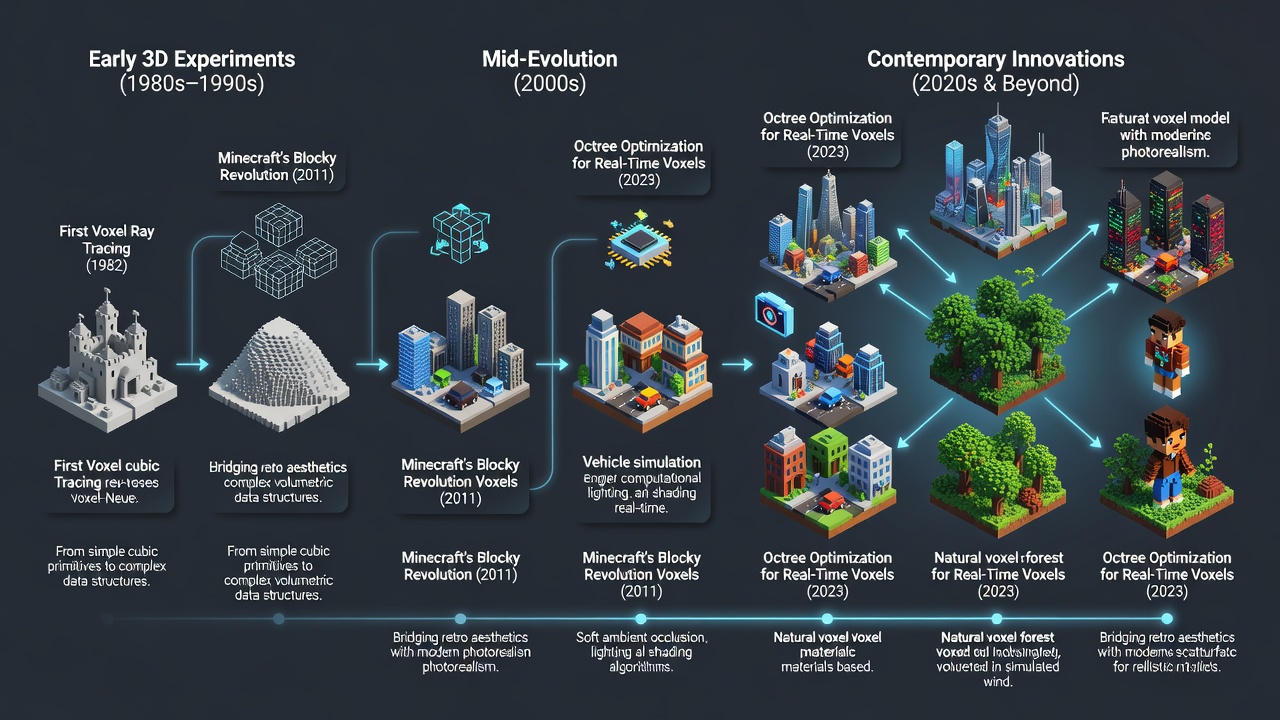
Engineers refined sparse voxel octrees during this period so that only occupied space consumed memory, and this change allowed worlds to grow to kilometers across without exhausting RAM on consumer PCs. Research groups at institutions in Australia published benchmarks comparing ray-tracing through octrees against GPU-accelerated mesh methods, and the results indicated that voxel approaches retained advantages for real-time modification even when polygon counts rose in competing engines. Studios released games such as 7 Days to Die and Teardown that extended these methods into survival gameplay loops where players excavate or construct entire structures, and the underlying engines continued to evolve through community forks hosted on public repositories.
Contemporary Indie Survival Titles and Future Directions
By 2025 several new survival experiences adopted hybrid pipelines that combine voxel storage for modifiable terrain with polygon meshes for characters and props, and titles like Nightingale and upcoming projects announced for 2026 integrate procedural voxel caves that respond to player explosives. Industry reports from the Game Developers Conference note that indie teams favor these techniques because they reduce the need for pre-authored level geometry while still supporting emergent gameplay. In August 2026 a scheduled update for one long-running voxel survival game will introduce GPU-resident sparse voxel buffers that further cut CPU overhead during large-scale destruction events, according to developer patch notes shared on official forums.
Conclusion
The lineage of voxel rendering therefore stretches from medical visualization and military simulators through open-source engines to the survival genre that dominates parts of the indie market today, and each stage added either memory efficiency or editing flexibility that later creators built upon. Continued academic work on out-of-core streaming and hardware-accelerated traversal suggests the approach will remain relevant as hardware capabilities advance, while survival game developers continue to rely on the same core data structures first explored decades earlier.